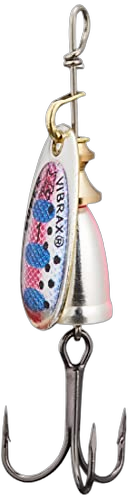
Blue Fox Classic Vibrax 1/8 oz
Blue Fox
Brass body, a little noise, a lot of history in pike and trout boxes. The spinner you find in a coffee can and still trust.
View on AmazonFish · Ictalurus punctatus / flathead
Two fish, one family argument. Channel cats will eat a spinner. Flatheads mostly want something alive, in a deep pool, after dark.
Where they live: Warm, fertile rivers and lakes, especially western and southern Minnesota. Flatheads keep to the big, slow rivers. Channel cats wander farther.
When folks chase them: Night in warm water for a channel cat. Winter is when both species tuck into deep, quiet water and stop performing.
Minnesota has two catfish. Channel and flathead. People say “catfish” the way they say “hotdish,” and then get mad when you show up with the wrong one.
I learned the whiskers are not the sharp part by poking myself on a spine and blaming a barbel, which is a very confident way to be wrong. The spine is in the leading edge of the dorsal fin and each pectoral fin. The pain is the poke. The DNR’s catfish page says it is not poison. Lock that in before you give a speech at the landing. (Minnesota DNR — catfish)
Tell them apart by the jaw and the tail. A flathead’s lower jaw sticks out a little, like an underbite, and the tail is square. A channel cat’s tail is forked. Small channel cats are steel gray with dark spots. Older ones go dark and lose the spots. (Minnesota DNR — catfish, biology)
Channel cat. The biology page says they are far more likely than a flathead to eat carrion, dead bait, and a spinner, plug, or jig. MinnAqua’s lesson gets specific about the night shift: 8–12 lb line, riffles and shallows, off the bottom, with stink baits, crayfish, worms, minnows, or cut bait. Daytime, or after a rain, it says fish pools or cover. They feed by smell and taste, and the best time it names is night. (Minnesota DNR — catfish biology, MinnAqua — channel catfish)
The artificial we can actually point at is a Blue Fox Vibrax, in the boat kit and Spinners and cast days. We do not have a stink-bait listing. We are not going to draw one.
Flathead. Different manners. The DNR says they usually take large live baitfish or gobs of nightcrawlers, lowered into deep pools or heavy cover. They generally shun the dead baits and stink baits people love for channel cats. An artificial is a rare occasion, not the plan. (Minnesota DNR — catfish biology)
No tray for that. Nightcrawlers and a live baitfish are a bait-shop conversation, not a card we can click.
For a channel cat, MinnAqua prints the line: 8–12 lb. It does not print a rod length, so neither will we. A medium spinning stick that can throw a spinner and still behave at night is the idea. The flathead page describes the presentation — bottom, deep pool, heavy cover — and does not hand us a blank length either.
The state-record channel cat on the MinnAqua page is 38 pounds and 44 inches, caught in 1975 on the Mississippi in Hennepin County. The biology page says a channel cat commonly runs 1 to 10 pounds and rarely passes 20, which can both be true. A record is not a Tuesday. (MinnAqua — channel catfish)
Flatheads are the largest catfish native to Minnesota. Commercial fishermen have reported fish larger than 100 pounds. The bullhead lesson, of all places, records the state record at 70 pounds from the St. Croix. (Minnesota DNR — catfish biology, MinnAqua — bullheads)
Both species are most prevalent in warm, fertile rivers and lakes in western and southern Minnesota. The Red, Minnesota, Mississippi, and St. Croix are the rivers the DNR names for catfishing. (Minnesota DNR — catfish)
Channel cats range through those rivers plus the St. Louis and many tributaries. They share riffly streams with walleye and smallmouth. The DNR notes they originally occupied the Mississippi only below St. Anthony Falls and have since been introduced as far upstream as St. Cloud. In a lot of lakes, especially where they are stocked, the numbers are maintained by stocking even though they can reproduce in still water. The agency says it raises about 30,000 yearlings a year at two hatcheries for that lake job. (Minnesota DNR — catfish biology, MinnAqua — channel catfish)
Flatheads keep to large, slow rivers: the Mississippi below the Coon Rapids Dam, the St. Croix below Taylors Falls, and the Minnesota. Deep pools, log jams, the kind of cover that looks like a mistake from shore. (Minnesota DNR — catfish biology)
On this site, Lake Pepin is the room that already says catfish.
Sitting a river at night with a channel cat in mind is one of the few fishing plans that asks you to be quiet on purpose. The fish is hunting by taste in water you cannot see through. That is the whole sport, and it does not need a louder lure to be real.
Channel cats spawn when the water hits 75 to 80 degrees, usually the early-summer window MinnAqua puts in late June. Flatheads spawn at 72 to 75. Both nest in cavities — hollow logs, root wads, log jams — and the male guards the eggs. (Minnesota DNR — catfish biology)
Winter is not a second summer. Flatheads move to deep water with boulders or logs out of the current and stay there, torpid enough that silt can dust them. Channel cats do the same kind of deep, sheltered wintering, and in big rivers the two can lie side by side. In spring a channel cat may run many miles upstream into smaller tributaries, then fall back late in the year. (Minnesota DNR — catfish biology)
Ice tip, such as it is: do not expect the night bite to clock in under a shack. The DNR’s winter sentence is deep and still. If the rulebook says you may fish, fish the season you are in, not the one you miss.
Limits move. Rivers that touch another state are border water. Look up the stretch by name before the cooler opens.
The boat kit
Blue Fox is here because the DNR says a channel cat will hit a spinner, a plug, or a jig. A flathead usually will not. We are not going to invent a stink bait so the card looks busy.
The tray
Blue Fox Vibrax slots for the days you want something that flashes, ticks, and does not require a TED Talk.
Blue Fox
Brass body, a little noise, a lot of history in pike and trout boxes. The spinner you find in a coffee can and still trust.
View on Amazon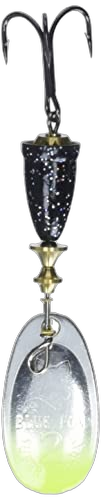
Blue Fox
Chartreuse-tipped and silver-flake — a color combo that looks like a gas-station candy and somehow still works.
View on AmazonmnFISHON is an Amazon Associate. We may earn a commission if you buy through this link. See the affiliate disclosure.